

Blog
Choosing Care in Worthing and Eastbourne With Confidence

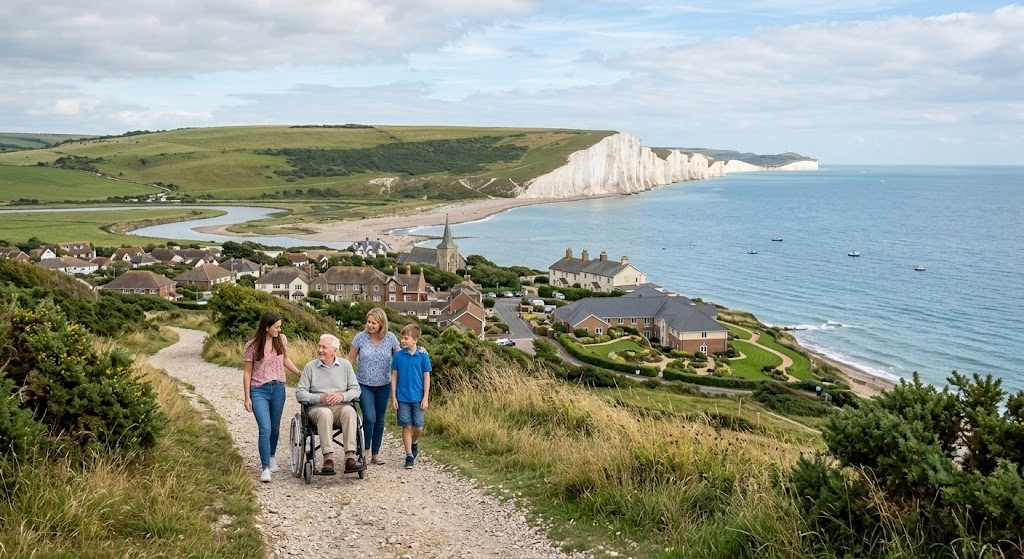
Anyone starting a care home search on the Sussex coast quickly notices there is no shortage of choice. Worthing and Eastbourne each have dozens of residential and nursing settings, ranging from small family-run homes with 15 or 20 beds to larger purpose-built facilities supporting many more residents. Families can use the Care Quality Commission care-home search to check whether a service is registered, read its latest inspection findings and compare official ratings. The real question is therefore not simply whether a place is available. It is how to separate suitable options from unsuitable ones without relying entirely on directory listings and marketing brochures.
Both towns are located in counties with considerably older populations than the national average. East Sussex County Council reports that approximately 26% of the county’s population is aged 65 or over, compared with around 18% across England. West Sussex has a similar age profile, with its latest population and ageing data showing that the county has a higher proportion of older residents than both the South East and England overall. This demographic weight has created a care-home market with genuine depth and breadth, but it has also produced staffing, capacity and specialist-care pressures that influence what families find when they begin making enquiries and arranging visits.
What the CQC ratings picture looks like on the ground

The Care Quality Commission inspects and rates every registered care home in England, using four ratings Outstanding, Good, Requires Improvement, and Inadequate. A common assumption is that in a well-established market like Worthing or Eastbourne, most homes will be sitting comfortably in the Good band. That is broadly true, but the pattern has some texture worth understanding.
In Worthing, of the 61 registered care homes, 49 hold a rating of Good or above. That works out at roughly 80% of the local market meeting the Good benchmark or better, with the remainder mostly in Requires Improvement. In Eastbourne the picture is similar 43 of 56 homes are Good or above, again around 77%.
That leaves a real minority in Requires Improvement in both towns. The West Sussex County Council market position statement for 2024 notes specifically that Arun and Worthing have the highest number of Requires Improvement beds in the county, though it also flags that these are the areas with the largest overall supply, so proportionally the picture is less alarming than the absolute numbers might suggest. Practically what this means for a family is that any home a search engine or directory throws up needs a direct check against its current CQC report, because the ratings distribution on the Sussex coast is not evenly good across every provider.
- The other detail worth catching is that a home’s overall rating collapses five separate assessments Safe, Effective, Caring, Responsive and Well-led into one summary label. A home rated Good overall might be Good on four and Requires Improvement on one, and which one it is matters.
- A home that is Requires Improvement on Safe reads differently from one that is Requires Improvement on Well-led. The CQC report shows the breakdown, and reading it takes about ten minutes per home. It is the single most valuable thing a family can do before booking a visit.
The dementia care pressure specific to the Sussex coast
The demographic weight of over-65s in East and West Sussex produces one particular pressure that shapes what families are looking at when they visit. Roughly one in eleven people over 65 in England lives with dementia, and the proportion climbs sharply after 80. On a coastline with 20% of the population over 70, that adds up to substantial demand for dementia specialist care.
- Both towns have responded to this in different ways. Worthing has around 24 care homes offering dementia care services, including several homes where dementia is the specialist focus rather than one part of a broader offer. Eastbourne has 17 homes offering dementia care within a smaller overall market. What has emerged in both towns is a tier of purpose-built dementia specialist homes, often newly opened in the last five to ten years, sitting alongside older converted-house residential homes that offer some dementia support within a general care setting.
- The distinction matters for families. A home registered for dementia care is not the same as a home with dedicated dementia units, a dementia trained team on shift 24 hours a day, and an environment designed around the needs of people living with cognitive decline. The CQC registration is the floor. What sits above it varies considerably from one home to the next.
The funding reality nobody explains until it becomes relevant

Care home fees in both towns run higher than the national average, reflecting both the demographic pressure and the general cost of the South East. Weekly self-funder rates in Worthing average around £1,548 and in Eastbourne around £1,446, though rates run higher in newly built nursing and dementia specialist homes and lower in older residential settings.
Local authority funding thresholds in England remain at £23,250 in capital assets for the 2026 to 2027 financial year, as confirmed by the Department of Health and Social Care’s guidance on social care charging. Below that figure, a resident may be eligible for support from West Sussex County Council or East Sussex County Council, depending on which side of the border they live on and the outcome of their care-needs and financial assessments. Above it, most residents are expected to pay the full cost of their care. The two councils operate independently, so their commissioning rates, assessment procedures and pathways from hospital discharge into residential care may work slightly differently. This is worth understanding when a parent is considering homes in both towns.
Worthing care homes: what the local market looks like

Worthing’s care home market is one of the largest on the Sussex coast, which is both an advantage and a complication. The advantage is genuine choice across residential, nursing, dementia and respite categories. The complication is that navigating that choice takes real time.
The town has a mix of older converted-house residential homes, mainly in the town centre and central residential streets, and newer purpose-built care homes on the outskirts, several of which have opened in the last few years. Homes like Tarring Manor and Merriman Grange represent the newer purpose-built end of the market, with larger bed counts, en-suite rooms, dedicated dementia units, and full nursing cover. At the other end, older residential homes such as St Mary’s Care Home (rated Outstanding by the CQC) have long-established local reputations built over decades of operating in the same premises.
Nursing care is the segment where availability is tightest. The town has 12 registered nursing homes, and demand for the higher-acuity beds sits close to capacity most of the year. Families looking for round-the-clock registered nurse cover with dementia specialism the combination most often needed when a parent’s care needs have escalated beyond what residential care can safely handle have fewer options and shorter waiting windows than families searching for straightforward residential care.
Purpose-built providers with combined nursing and dementia registration include operators such as Hallmark Luxury Care Homes, whose care homes in Worthing offer nursing care with registered nurses on shift 24 hours a day alongside residential and specialist dementia provision. This kind of dual-registration setting has become more common in the last five years as operators respond to the demographic shift, and it matters practically because a resident whose needs change over time can often continue in the same home rather than being moved when their care requirements escalate.
Eastbourne care homes: what the local market looks like
Eastbourne’s care home market is slightly smaller than Worthing’s but has a similar structural mix older residential homes across the town centre and Meads, and newer purpose-built provision on the outskirts and in Willingdon.
Eastbourne Gardens, operated by Avery Healthcare, holds the town’s only current CQC Outstanding rating and has become a benchmark for what a large purpose-built home in the area looks like. Other established providers include HC-One, which runs Coppice Court and Elstree Court in the Meads area, and Barchester’s Mortain Place. East Sussex County Council itself operates one nursing home in the town, Milton Grange, alongside its wider social care provision.
The newer purpose-built end of the Eastbourne market has grown substantially in the last few years. Hallmark Willingdon Park Manor, an 85-bed home in Willingdon three miles from the seafront, is one of several newer settings offering combined residential, nursing and dementia care under one roof.
- Families evaluating care homes in Eastbourne with combined nursing and dementia registration will find that the newer purpose-built end of the market has substantially more of this dual-registration provision than the older converted-house end of the market, which tends to be residential-only.
- One thing worth flagging about the Eastbourne market specifically. The town sits within East Sussex’s ageing demographic profile, and the CQC’s 2025 assessment of the county specifically identified nursing capacity as a pressure area. Families searching for nursing beds in Eastbourne may find availability tighter than the raw number of registered homes suggests, particularly for dementia nursing at the more acute end.
The visit is where the paper picture and the real picture meet
Research narrows the shortlist. The visit tells you which of the shortlisted homes is actually right for your relative. A few things families often notice too late.
- Watch how the team interacts with residents when they think no one is looking. Warm interaction during a manager-led tour is standard practice. Warm interaction in the corridor between rooms is a truer signal.
- Ask how new residents are helped to settle in the first few weeks, and how the team builds a picture of the person’s history, preferences, and routines. A home that has a specific process for this usually has one because it works.
- Ask about staff continuity. How often does the same care team see the same residents. High turnover across the sector means most homes have some churn, but the pattern varies considerably between providers.
- Ask about the last CQC inspection specifically what came up, what changed, what the home has done since. A manager who talks openly about this is running a home that takes regulation seriously. One who deflects is running one that does not.
- Look at meal times. How much choice residents have, how the food is served, whether people eating in their rooms are checked on, whether the atmosphere in the dining room feels like a canteen or a shared meal.
The visit is also the moment to raise questions about care planning, medication management, GP arrangements, and how the home communicates with families when something changes. A home that answers these questions specifically and comfortably is usually one to trust. One that answers in general reassurance is one to keep looking at.
References
Care Quality Commission Rating structure and inspection framework for adult social care in England
- https://www.cqc.org.uk/what-we-do/how-we-do-our-job/ratings
Care Quality Commission CQC rates East Sussex County Council’s adult social care provision as good (2025 assessment)
- https://www.cqc.org.uk/press-release/cqc-rates-east-sussex-county-councils-adult-social-care-provision-good
Care Quality Commission East Sussex County Council local authority assessment (26% over-65s and 20% over-70s data)
- https://www.cqc.org.uk/care-services/local-authority-assessment-reports/eastsussex-1025
West Sussex County Council Older People’s Bed-Based Care Market Position Statement (June 2024) occupancy, CQC distribution, and demand data
- https://www.westsussexconnecttosupport.org/alt-home/market-position-statement-and-commissioning-strategy/west-sussex-county-council-older-people-s-bed-based-care-market-position-statement-june-2024/
East Sussex County Council Care homes information and Milton Grange nursing home reference
- https://www.eastsussex.gov.uk/social-care/leaving-home/care-homes
Care Choices Care Homes in Worthing, West Sussex (CQC ratings distribution and specialisation data)
- https://www.carechoices.co.uk/browse/south-east/west-sussex/worthing/
Care Choices Care Homes in Eastbourne, East Sussex (CQC ratings distribution and specialisation data)
- https://www.carechoices.co.uk/browse/south-east/east-sussex/eastbourne/care-homes/
Care Sourcer Care Homes in Worthing (49 of 61 homes rated Good or above)
- https://www.caresourcer.com/s/providers/districts/worthing/care-home
Care Sourcer Care Homes in Eastbourne (43 of 56 homes rated Good or above)
- https://www.caresourcer.com/s/providers/towns/eastbourne/care-home
TrustedCare Weekly care home cost data for Worthing (£1,548 average)
- https://www.trustedcare.co.uk/care/care-homes-in-worthing
Lottie Weekly care home cost data for Eastbourne (£1,446 average) and directory of local providers
- https://lottie.org/care-home/england/east-sussex/eastbourne/
Age UK Paying for a care home and local authority funding threshold (£23,250 capital assets)
- https://www.ageuk.org.uk/information-advice/care/paying-for-care/paying-for-a-care-home/