

Blog
Are AI Glasses a Real Corporate Productivity Tool or a High-Tech Distraction?


AI glasses are not an automatic ticket to a corporate promotion. They are simply replacing traditional headphones and screens for multi-tasking professionals who want hands-free access to data, audio, and visual recording. If your goal is to eliminate digital friction during client meetings or field operations, smart glasses streamline your workflow by feeding you real-time information without requiring you to stare at a smartphone. However, if you already struggle with focus, adding an internet-connected feed directly to your face will decimate your daily attention span. They are a tool for optimization, not a cure for lazy work habits. Silicon Valley sells a fantasy of instant competence. The reality is far more mechanical. It just changes where the distraction lives. You manage the tool, or it manages you.
What Are AI Glasses and How Do They Function in a Professional Setup?
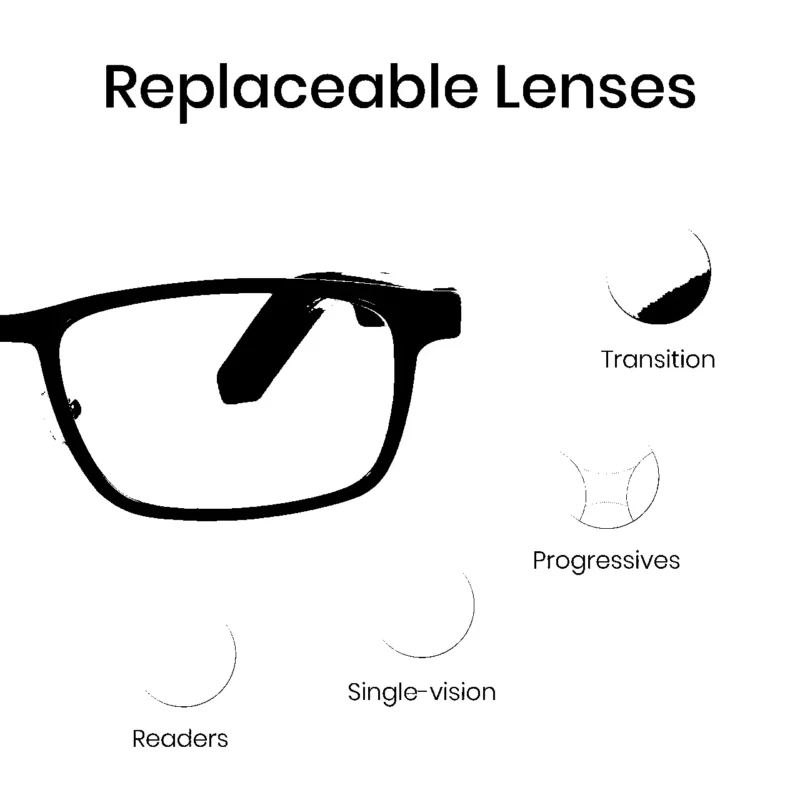
Smart eyewear shrinks a micro-computer to fit inside a standard spectacle frame. Instead of a bulky headset isolating you from reality, these devices use directional speakers, integrated microphones, and tiny camera sensors to interact with an artificial intelligence assistant running on your phone. They do not project heavy holographic environments into your eyes yet. They focus on ambient utility.
You tap the frame. You speak a command. The integrated AI whispers the answer into your ear.
For corporate professionals, this translates to a screen-free method of handling administrative overhead. Picture yourself skimming a client brief while dodging slow walkers at terminal gates. Or logging notes during a chaotic project walkthrough. You don’t dig for your phone. You don’t fumble with a laggy dictation app. You just talk to the air and keep moving.
The glasses offload the physical friction of interacting with software. They turn digital inputs into a voice-driven background layer. It is a subtle shift that changes how knowledge workers manage information density throughout a chaotic workday. The hardware relies entirely on cloud computation to offload physical latency.
Why Are Modern Professionals Shifting to Smart Eyewear?
Standard mobile interfaces are failing to keep up with the volume of modern communication. Professionals are drowning in notifications. Checking a phone requires physical effort, eye contact displacement, and a break in spatial awareness. Smart eyewear keeps your head up. It allows you to maintain direct eye contact during client interactions while receiving subtle audio cues or data summaries.
Look at the numbers. Counterpoint Research tracked a 139% YoY spike in global smart glasses shipments in late 2025. That is a ridiculous jump. It tells you everything you need to know about where the market is heading. People are finally throwing away those glorified Bluetooth speakers they used to wear on their faces. They want real processing power. This isn’t some passing tech-bro hype cycle. The corporate money moving behind the scenes is heavy and calculated. With the smart glasses market hitting an estimated $3.2 billion in 2026, major enterprise buyers and high-rolling operators are quietly burning through capital to buy an edge. They aren’t collecting toys. They are buying efficiency.
Consider the practical utility of audio frames in a fast-paced environment:
- Instant contextual retrieval of a client’s past purchase history right before entering a boardroom meeting.
- Hands-free documentation of field notes or spontaneous brainstorm sessions without stopping your physical movement.
- Discreet notification filtering that allows only high-priority executive emails to trigger an audio summary, silencing the endless Slack noise.
This is about aggressive time-arbitrage. If a device saves an executive four minutes per hour by eliminating phone handling, it pays for itself in a quarter. The market understands this efficiency calculation perfectly.
How Do AI Glasses Impact Your Daily Networking and Career Growth?
Corporate survival comes down to optics and positioning. When you try to expand your professional network, you have exactly five seconds to set the hook. Fail there, and the relationship is dead on arrival. Fumbling with a phone or checking a smartwatch screams that you have somewhere better to be. It is a rapport killer. AI frames let you maintain intense, uninterrupted presence while an algorithm silently handles the data collection in the background. You stay locked in the room.
But you have to calculate the optics. Showing up to a high-stakes partner dinner wearing clunky, obvious tech makes you look ridiculous. The integration must be flawless. It needs to pass for high-end eyewear while serving as a ghostwriter nobody else knows exists.
“The highest-performing executives do not work harder; they build systems that minimize cognitive drag.”
A sophisticated career coaching strategy emphasizes the elimination of administrative friction. If you spend half your day typing up notes from meetings you just attended, your upward mobility is stalled by your own operational bottlenecks. Smart glasses with embedded recording and AI transcription capabilities allow you to offload that labor entirely. You finish the conversation, tell the assistant to format the transcript into action items, and send it to your team before you even reach your vehicle. You become faster, more responsive, and vastly more efficient than peers who stick to legal pads and keyboards.
What Are the Real Risks to Workplace Focus and Routine Productivity?
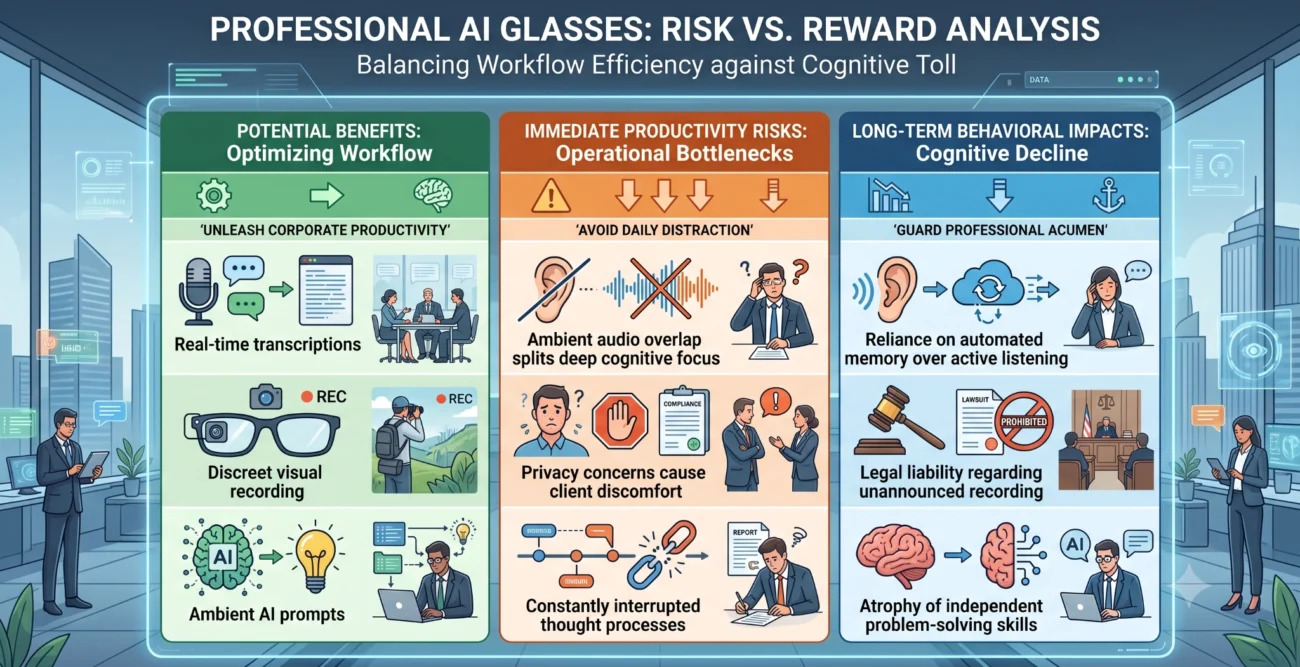
The marketing materials for smart eyewear promise an effortless flow state, but the operational reality can be messy. Distraction does not disappear just because it is projected through a tiny lens or pumped directly into your auditory canal. It becomes harder to guard against. When notifications are delivered straight to your face, the barrier between deep work and cognitive pollution drops to zero.
The broader workforce is rapidly embracing these automation tools, sometimes without considering the psychological toll. The shift is already happening right under your nose. Pew Research found that about 21% of US workers use AI for their jobs as of late 2025. That is one in five people quietly tethered to an algorithmic leash. It is climbing. Gallup backed this up, tracking the ground truth that daily AI use at work ticked up to 10% in late 2025. This isn’t futuristic hype anymore. Machine learning has become ordinary infrastructure for millions of cubicle dwellers. They simply cannot function without the crutch.
This constant accessibility can quickly erode healthy professional routines. If your frames buzz with alerts while you draft an executive report, your focus is shot. The brain cannot process a dual stream of physical reality and complex digital data simultaneously.If you do not set strict boundaries on what notifications are allowed into your eyewear, you are just building a faster machine to burn out your brain. The goal is to control the input, not to let the input control your field of vision.
How to Select the Right Smart Glasses Without Buying into Vendor Hype?
Most tech review sites treat smart glasses like toys, focusing on audio quality for podcasts. For a corporate operator, those metrics are irrelevant. You need to look at battery life, microphone isolation, ecosystem compatibility, and how natural the frames look in a professional setting. If you look like a sci-fi extra during an investor pitch, you have already lost the room.

The market has fractured into distinct hardware tiers based on actual utility, not marketing fluff. First, you have audio-only frames. These bypass cameras and displays completely, mimicking standard designer spectacles while hiding directional micro-speakers aimed at your ears. They are perfect stealth tools for locked-down corporate environments where compliance departments ban cameras on sight, serving as an invisible pipeline for phone calls and quick audio briefs. Step up to devices with integrated cameras and you introduce raw visual capture. This tier lets operations managers and logistics consultants document infrastructure or live-stream site layouts to offsite teams without lifting a finger. For an operator who needs to balance clean executive aesthetics with functional machine intelligence, checking out market leaders like the Meta AI glasses sets the actual standard. They pass for normal fashion eyewear, meaning you can walk right past corporate security without triggering an awkward compliance investigation. Finally, you have full augmented reality HUDs that slap graphs and text overlays directly onto your lenses. They sound powerful on paper. In reality, they are heavy, suffer from garbage battery life, and look completely ridiculous. For the average knowledge worker grinding in a hybrid office, a full HUD is an overpriced, physically uncomfortable piece of overkill.
Look at your daily calendar. If your day consists of back-to-back calls and strategic report writing, prioritize an audio-forward frame. If your day involves touring facilities, meeting suppliers, or evaluating real estate, opt for a camera-enabled option that automates documentation. Do not purchase features you will never use just to feel futuristic. Pick the specific tool that solves your primary operational bottleneck and leave the gimmickry to the amateurs.