

Blog
Why More High Performers Are Quietly Struggling With Burnout


More high performers are quietly struggling with burnout because organizational systems reward their silence with more work, while their own identity remains deeply tied to constant output and over functioning. Unlike typical underperformance, this “silent burnout” hides behind met KPIs, smiles in meetings, and flawless delivery, making it an invisible corporate epidemic. High achievers are not breaking because they lack resilience they are breaking because their resilience is being used as a structural safety net.
From the outside, high performers often look like they have everything under control. They hit deadlines, lead teams, build businesses, raise families, stay active, answer emails at odd hours, and somehow still show up polished and prepared. People admire their discipline, their drive, and their ability to handle pressure. What often goes unseen is the internal cost.
The Burnout Paradox
The traits that make professionals excel are the exact traits that leave them vulnerable to severe mental fatigue.
- Load Concentration: Leaders push excess tasks to reliable employees who solve problems quietly.
- Competence vs. Capability: High achievers equate being skilled with an endless capacity to absorb stress.
- The “Fine” Mask: Driven professionals normalize chronic sleep loss and internalize panic to protect their reputation.
- Lagging Indicators: Metrics look stable because output is the last thing to fall when a person collapses.
Key Drivers of High Performer Burnout
| Driver | Personal Trigger | Workplace Catalyst |
|---|---|---|
| Over-Functioning | Tying personal self-worth strictly to professional output. | Celebrating constant availability without enforcing rest. |
| Imposter Syndrome | Pushing past physical limits to prove competence. | Rewarding results while ignoring toxic, chaotic friction. |
| The Safety Net Trap | Feeling guilty about saying no or letting down the team. | Using top performers to fill gaps left by underperforming staff. |
| Stagnant Impact | Sacrificing family, friends, and health to keep working. | Providing high workloads but zero clarity on long-term direction. |
Understanding the Burnout Paradox
Burnout often feels confusing because it doesn’t behave the way most people expect. You can be successful, productive, even admired for your performance and still feel completely drained inside.
This contradiction is what many experts refer to as the burnout paradox: the same behaviors that create success can also quietly lead to exhaustion.
When Burnout is More Than Stress
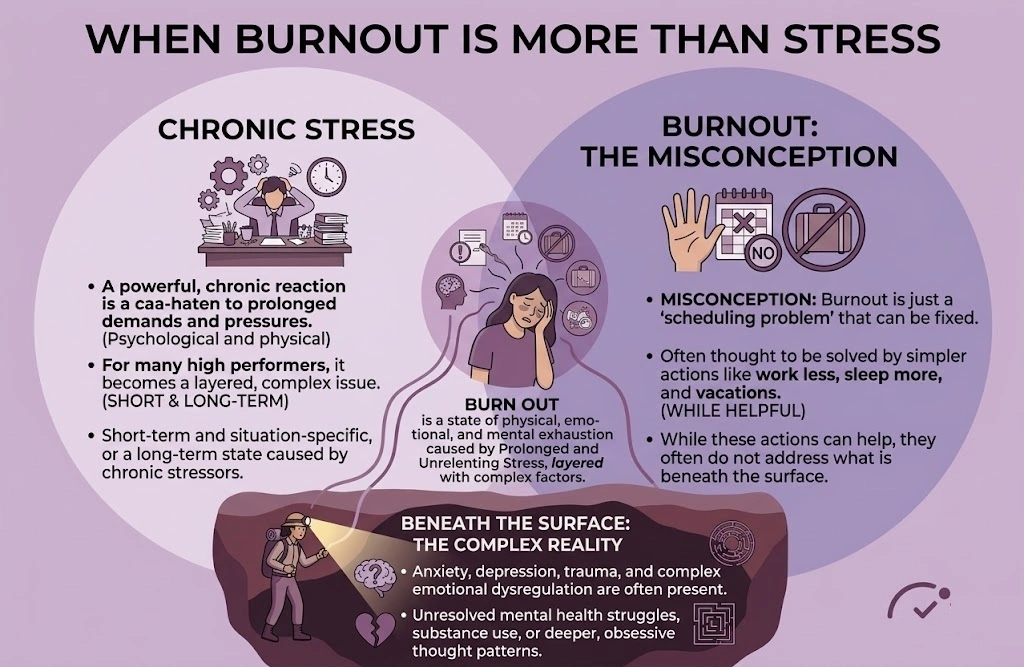
One of the biggest misconceptions about burnout is that it is simply a scheduling problem. Work less. Sleep more. Take a vacation. While those things can help, they often do not address what is happening beneath the surface. For many high performers, chronic stress is layered with something deeper. Anxiety, depression, trauma, obsessive thought patterns, substance use, emotional dysregulation, or unresolved mental health struggles may all be part of the picture.
- That is why integrated care matters. Looking for dual diagnosis treatment in San Diego, holistic care in Phoenix, or specialized treatment in Seattle can help people treat both mental health conditions and substance use issues simultaneously rather than addressing one while ignoring the other.
The Return of Mindfulness in a Hyperconnected World
There is a reason mindfulness keeps showing up in conversations about mental health, leadership, and resilience. It works, but perhaps not in the way many people assume. Mindfulness is not about sitting cross-legged in silence for an hour. At its core, it is about awareness. It is the ability to notice your thoughts, your body, your emotions, and your patterns before they begin running your day.
Ancient mindfulness practices are finding new relevance in modern mental health conversations. That makes sense. We live in a world where attention is constantly being pulled in a hundred directions.
Notifications, meetings, texts, deadlines, and social feeds can create a nervous system that rarely feels safe enough to slow down.
Why Success Can Increase Emotional Risk

Success solves many problems, but it can create new ones. The more responsibility someone carries, the harder it can become to admit they are struggling. Leaders often feel pressure to be the calmest person in the room. Entrepreneurs feel responsible for employees, clients, and families. Parents feel like everyone is depending on them. Professionals who are known for competence may fear that vulnerability will damage their credibility.
So instead of asking for help, many push harder. They wake up earlier, work later, drink more coffee, and ignore the warning signs. Then they tell themselves things will calm down after the next launch, the next quarter, the next promotion, the next big project.
The Physical Signs Many People Ignore
Burnout rarely starts with emotional collapse. It often starts with subtle physical changes. Sleep becomes lighter or more fragmented. Recovery after exercise takes longer. Focus becomes harder and small decisions feel heavier. Some people experience digestive issues. Others notice headaches, jaw tension, racing thoughts, shallow breathing, or unexplained fatigue.
- Because high performers are used to functioning under pressure, they often normalize these signals instead of paying attention to them.
- They convince themselves that they are just busy and they will rest later. The stressful season they are in never seems to end. The body is often the first place burnout becomes visible.
The Recovery Gap Problem
High performers often try to recover using short breaks, but the deeper issue is the gap between demand and recovery time.
| Demand Level | Recovery Provided | Result |
|---|---|---|
| High workload | Weekend rest | Temporary relief |
| High workload | Occasional vacation | Reset, then relapse |
| High workload | No boundary change | Chronic burnout |
What Actually Starts to Help
Real recovery is not just rest it is redesigning how energy is used.
Key shifts that matter
- Reducing “always-on” expectations.
- Creating true non-work mental space.
- Delegating before overload, not after collapse.
- Separating identity from output.
- Normalizing boundaries as performance protection.
Why High Performers Often Struggle to Ask for Help

Many ambitious people have built their identity around being capable. They are the fixer, provider, leader, and dependable one. Asking for help can feel unfamiliar, uncomfortable, or even threatening. If your value has been tied to productivity for years, slowing down can feel like failure. Rest can feel unearned. Vulnerability can feel risky.
But the truth is that emotional resilience is not built by pretending nothing affects you. It is built by recognizing when something does. Some of the strongest leaders are not the ones who never struggle. They are the ones who learn to respond to struggle before it becomes a crisis.
Final Reflection
High performers are not quietly struggling because they are failing. They are struggling because they are functioning too well for too long without interruption. The system rewards output, not sustainability. But long-term success depends on both. Burnout is not the opposite of performance it is often its hidden cost. And recognizing that early is what turns exhaustion into adjustment, rather than collapse into crisis.